Showing posts with label elementary. Show all posts

Tuesday, November 10, 2009

American Heritage


There is a saying that "the best things in life are free", and this certainly holds true with American History curriculum provided by the American Heritage Foundation. I received a CD from American Heritage with their Elementary English language, Elementary Spanish version, Middle School and High School level American History curriculum to review for TOS Review Crew. Although American Heritage always provides their curriculum for FREE I promised to review this product in exchange for them mailing it to me.

The American Heritage Foundation is "a non-profit corporation dedicated to the understanding and teaching of our nation's factual and philosophical heritage to promote freedom, unity, progress and responsibility among our students and citizens." (AHEF purpose statement) AHEF provides materials to students, families and schools to help students become "thoughtful, active and productive citizens." Their curriculum, America's Heritage: an adventure in liberty consists of 10-14 different units designed to focus on four key themes at all levels. The themes are Freedom, Unity, Progress, and Responsibility. The program is designed to be used as a year long supplement or as an intensified study during the month of November proclaimed American Heritage Month by the foundation.

Each level of America's Heritage contains an 11 page essay written for the teacher and intended as background to aid in teaching the curriculum. Detailed lesson plans listing the purpose, objective, theme and core knowledge points, expected time required for each lesson, materials and preparation checklists are written on the first page of each unit. Elementary lessons are designed for grades 1-5, middle school for grades 6-8 and high school for grades 9-12.

The elementary level lessons include directions and text for activities like group discussion, essay writing, role playing, games, songs, puzzles, journal entries, art and other creative ideas. One such activity suggested in the Colonial America unit is a game that requires students to play the parts of King of Great Britain, Parliamentarian Governor, Merchant or Colonist with variations for classes with 20, 25 or 30 students. Since America's Heritage is designed to be used with classrooms of children it makes an excellent curriculum for homeschool co-ops.

My friend and fellow teacher, Kelley Chin, chose America's Heritage to use with her homeschool co-op class this school year. When I asked her for her opinion of the curriculum she eagerly responded. "I am using this curriculum. I love it! The students really seem to enjoy it too! Every lesson is interactive to give the students a tangible way to learn the material. It is very patriotic! All of the lessons are based on the founding principles of our country. As soon as I saw the add in TOS magazine, I knew that this was the way I wanted my children to learn about the birth of our nation!!" she said


Elementary units of the curriculum cover the following points of American history:

* Colonial America
* Declaration of Independence
*John Hancock's Signature
*George Washington
*U.S. Presidents
*The Great Seal
*History of Thanksgiving
*The United States Flag
*The Star Spangled Banner
*The National Motto
*The Statue of Liberty
*The Pledge of Allegiance
*America the Beautiful
*What is an American?
* plus an extra teacher's supplement regarding religious expression in public schools

Middle school lessons and activities are varied much like the elementary level of America's Heritage. A sample activity while learning about the Constitution involved learning the Preamble of the Constitution in sign language. The 182 page Middle School curriculum has units for the following topics:

*Colonial America
*Lives, Fortunes, Sacred Honor (the history of the men who signed the Declaration of Independence)
*Declaration of Independence
*U.S. Constitution
*Thanksgiving
*Bill of Rights: Rights and Responsibilities
*Our National Documents
*The U.S. Flag
*The Star Spangled Banner
*The Gettysburg Address
*The National Motto
*The Statue of Liberty
*The Pledge of Allegiance
*What is an American?

The high school level curriculum offers greater opportunities for vocabulary study and discussion compared to the elementary and middle school levels. For example, students are instructed to read through the text of the Constitution and Bill of Rights, included with the curriculum, and then write their own personal Bill of Rights. High School level units include:

*Mayflower Compact
*The Declaration of Independence
*Federalist 47
*U.S. Constitution
*Bill of Rights: Rights and Responsibilities
*The First Ammendment
*Our National Documents
*Entrepreneurs in History
-Cornelius Vanderbilt
-Andrew Carnegie
-James Hill
-John D. Rockefeller
*America's Creed
*U.S. Flag/ Federal Flag Code
*Religious Expression in Public Schools
*What is an American?

America's Heritage: an adventure in Liberty is an excellent curriculum for students of all ages and the price is right! Persons interested in obtaining their own copy can do so by ordering a FREE CD on the website or if preferred purchase any level printed and placed in a binder for only $19.95 each. Payments can be made on-line through PayPal.

For more information about America's Heritage or the American Heritage Education Foundation become a fan on Facebook or visit their website at www.americanheritage.org. Once you have I think you will agree that some of the best things in life still are free.


Tuesday, November 3, 2009

Vantage Learning/ My Access!


MY Access!® Home


"If there's a book you really want to read, but it hasn't been written yet, then you
must write it."� -- Toni Morrison

Something happens to my children when they enter 7th grade. I lose a bit of my all knowing powers and they begin to question many things I share with them during the school day. Some would say it is a sign of disobedience, but I really think it is a sign of growing up. As they begin to learn and grow during these years they are also preparing for life away from me. It is during this time that I encourage independent study especially in the areas of subjectively graded
subjects, like writing.

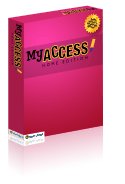
Vantage Learning sent me a one year membership to their on-line writing curriculum, My ACCESS Home Edition, to use with my children in exchange for a TOS Review Crew review. I was thrilled to oblige as our homeschool is currently experiencing the joys of teaching 7th and 10th grade writing. With my limited all knowing powers surfacing on a daily basis I was in desperate need of a fresh curriculum to help me with teaching. I discovered MY ACCESS is a homeschool Mom's dream come true.

A complete on-line curriculum, MY ACCESS allows teachers to set goals and
requirements and then, acting as a teacher's best friend, holds the student accountable. With clever on-line lessons, evaluation tools, and follow up activities and suggestions for revision, MY ACCESS teaches writing for excellence and proficiency. Available as a yearly subscription for $99.95 which allows use by up to 6 students, My ACCESS Home Edition is an incredible value for homeschool families.


For any homeschool teacher who has shuddered at the thought of teaching the art of essay writing My ACCESS includes a complete writer's guide. The writer's guide, an on-line textbook, is designed to help familiarize readers with the writing process and the key writing traits which My ACCESS concentrates on throughout the curriculum. These writing traits include: focus, content development, organization, language use and mechanics.


When I first received my email acknowledging my account subscription, user name and password, I registered my students quickly and easily. Logging into the site took seconds and once on I found the registration process straight forward and easy to understand. Tutorials, a Parent User's Guide, Student User's Guide and Frequently Asked Questions page were accessible from the home page if I needed them to guide me through the learning curve of understanding all the facets of the program. After spending about an hour reviewing all the information I felt I had a good handle on how to make the most of My ACCESS and was thrilled by all the possibilities.

I registered Micah, 7th grader, Jonah, 10th grader and Sierra, 2nd grader on my account choosing essay selections for each student based on their ages and abilities. Each student was assigned a unique user name and password allowing them to log in at a later time to check assignments and begin work. After registration My ACCESS allowed me to set deadlines, print out master schedules and set award levels for each student based on points earned. For example, in an effort to bribe, I mean encourage, my 7th grader towards diligence I chose a point value for various activities and writing assignments completed. Next, I chose an award incentive and deadline to receive the award. Since I had already chosen to receive email notification of progress reports to help me track student progress without direct daily intervention, I knew nearly as quickly as Micah that she had met her goal of 250 points by her deadline of 10/31 and should receive her award of a special movie night with Mom.

As I chose the suggested topics to assign I was pleased to note a customize option. Both Micah and Jonah participate in a Philosophy co-op class and had a written assignment due. I easily added a description of their assignment under the My Topics option allowing My ACCESS to coach them through getting their assignment to its final draft.

If I still needed inspired writing prompts for assignments which would please everyone My ACCESS offered a topic wheel option for optimal creativity. The topic wheel assists the teacher in randomly choosing a beginning, middle and end for the topic. After giving it a spin I came up with Write a rap (beginning) that convinces a famous actor (middle) to transform into something else (end). All of these options were made available to me after deciding I wanted a persuasive essay for ages 15-18. Fantastic!

I sat down with 7th grader, Micah to watch and take notes as she logged on to her personal account the first time. She needed very little instruction from me in regards to locating assignments and choosing options presented to her. "It was easy because all you had to do was put in your user name and password and then click assignments and you were basically there", she commented.

Micah chose to attempt Informative Essay writing first. Rather than diving into writing I asked that she watch the helpful tutorial lesson first. My Access lessons are hip and interesting all based around the premise that the student has just been hired as a reporter for the My ACCESS Daily News and will receive some on the job training. The "editor", a smartly dressed cartoon version of a young professional woman, greets the student welcoming them as they begin Chief Reporter Training. For Informative essays the training consisted of three modules of lessons all taking about 5 mins. to read through and complete. The third module taught how to read and benefit from the My ACCESS evaluation rubric which appears once the student submits their first draft of their essay. Other modules included information regarding writing an introduction, body paragraphs and conclusion for their essay. Each lesson concluded with a vocabulary matching activity for terms discussed within the lesson. This activity was graded immediately and allowed the student to print results for easy record keeping.

While Micah wrote her essay she discovered an on-line translation tool for English to Spanish and an on-line dictionary complete with synonyms and usage examples. She made use of the dictionary as she revised her essay saving her a trip to the bookshelf for the thesaurus.

"I think MY ACCESS is one of the most fun writing curriculums I have used. I like how you can go and do activities or exercises to help you understand everything. I also like how it takes you step by step through everything with the evaluation rubric making sure I understand and grading me", said Micah.

My 10th grade student, Jonah, made use of a customized assignment I had chosen to help him meet the requirements of his essay required for Philosophy class. He and I discovered that once complete we could ask My ACCESS to publish the essay in the ACCESS Daily News and have the current edition delivered to any email inbox; a great way to keep grandparents and other interested family members up to date. Student's essays are published in a typical column format on a mocked up newspaper page. My ACCESS allows the choice of page color, type and style. We chose a light beige paper with a font we thought supported an essay that compared and contrasted the rhetoric of Socrates and one of his students. When Jonah's essay arrived in my inbox I thought it looked impressively well written and professional. I was pleased to note the look of satisfaction from Jonah and positive comments seeing his work published in such a format.

When asked his opinion regarding My ACCESS Jonah said, "It's a good writing curriculum. I like it because it grades your essays giving you a percentage to know where you are at. You don't have to guess at what you need to change to make your paper better. I would recommend My ACCESS for high school writing assignments".

Each time I signed into MY ACCESS after registration I easily checked on student progress by utilizing an abbreviated report on my home page known as the Writing Dashboard.
Writing Dashboard
Student:Jonah SpoerndleSubmissions:3
Overall Progress:
Student:Micah SpoerndleSubmissions:5
Overall Progress:
I liked using the Dashboard for quick checks on student progress in case I forgot to ask them personally in the midst of a hectic day. The Writing Dashboard displays the number of essays submitted for each child, plus an average writing performance labeled either below proficient, proficient or advanced proficient. Additionally it allowed me to easily access the drafts of each student's essays seeing where their specific strengths and weaknesses fell, revisions attempted and development from rough draft to finished product.

I was impressed with all My ACCESS Home Edition offered me in the areas of lesson planning and supervision options. When juggling multiple subjects for multiple students in upper grades I can use all the assistance a curriculum can offer. My ACCESS Home Edition is an excellent tool for teaching, encouraging and providing instant feedback to young writers. Who knows it may even help you regain some of your all knowing power when you need it the most.

Monday, September 28, 2009

A Journey Through Learning


Fourteen years ago when I began my homeschool journey I was always the odd Mom out. Most of the families in my homeschool support group were lovers of standard textbook curriculum. We were not. I loved the concept of the unit study and chose them as our primary source of learning. I continually searched for non-traditional ways to process our learning adventures and when I enthusiastically explained about them to friends I was usually rewarded with blank stares of disbelief and confusion. More times than not I would hear comments such as “Oh, I’m just not creative enough to do all of that!" or "I could never handle all that mess in my house”.
A Journey through Learning is a company designed to help those less adventuresome families who think “they can’t” when it comes to unit study learning. A Journey Through Learning currently sells 8 different prepared unit studies for families to try covering history and other social studies topics. All unit studies are designed to teach children in grades 2-7 or 8. In addition to unit studies, A Journey Through Learning offers 47 lapbooks complete with study guides designed for students pre-school- grade 7.

If the term LapbookTM is a new one for you it is time you became acquainted. I learned of LapbooksTM a few years ago and quickly fell in love with the idea. Lapbooks consist of a file folder bent into a new form filled with little mini booklets all designed to summarize information in varying ways regarding a topic studied. Lapbooks have an artsy-crafty feel, but serve as a practical educational tool. They work especially well with unit study families as a way to capture all the varied information related to the topic being studied.

A Journey Through Learning e-mailed three lapbooks in e-book format for our family to try. I chose to dive into the Autumn Lapbook with Study Guide first. My test victim, I mean student, was my 2nd grader, Sierra and she has loved every minute of the study. Together we have read through most of the background information provided and chose which mini-books to create as suggested. We began the study trying to incorporate her Kindergarten brother, but quickly discovered that the age suggestions of 2-7th grade were right on target. This lapbook was a bit too challenging for my Kindergarten student.

Preparation consisted of printing off the lapbook pages in their entirety and then placing them in a file folder. A Journey Through Learning suggests putting all pages in a three ring binder, but we were satisfied with using a file folder. Topics covered within the Autumn lapbook include Fall Equinox, calendar of fall months, science of leaf colors, foods of autumn, fall holidays, vocabulary words associated with fall, nature study activities for the fall, migrating birds, and a few jokes and puzzles for fun.

Each day of study is spent reading through the background information provided and then making a small booklet to reinforce the material learned. For example our second day with the the Autumn Lapbook we read a brief article regarding the Fall Equinox. We looked up the date on our family calendar and discussed in great detail the amount of daylight versus darkness. Next, Sierra created a two little booklets one reviewing the fall equinox and another of small calendar pages. We marked important dates on the calendar pages like her sister's birthday and Sierra's birthday. As we placed the little booklets into the file folder delight settled in Sierra's eyes as the vision of a finished product began to unfold.

A Journey Through Learning states their purpose is to "create delight filled learning experiences". Sierra smiled as she gazed at her lapbook and said, "Can we show this at the Project Fair at the end of the year?" "Absolutely", I said, taking note that this experience was not only delight filled, but memory making all in one.

A Journey Through Learning offers their lapbooks as digital downloads for $13.00, CD’s for $14.00 or printed copies for $21.00. Study guides and other useful suggestions for further topical study are included in each lapbook purchase. Full descriptions and sample pages can be viewed on the company’s website at www.ajourneythroughlearning.com

Thursday, April 9, 2009

Exploring Creaton with Zoology 1: Flying Creatures of the Fifth Day

I never felt the need to spend much time during elementary years studying science. Maybe it was the amount of necessary time spent conquering the basics and not wanting to keep my little kids in school all day, but I always had a gap in their education in regards to science lessons for my oldest kids before 7th grade. Our homeschool evolved however a few years ago as Apologia Educational Ministries began to release their elementary science series of books. Already familiar with the quality Apologia offers homeschoolers in the upper grades, I was anxious to purchase a title to start filling a long existing gap for our homeschool.

Once only offering high school level sciences, Apologia currently has 5 different elementary volumes all written by Jeannie Fulbright with the Charlotte Mason methodology of teaching in mind. Exploring Creation with Zoology 1 was the third elementary science text we have used in our homeschool having previous experience with Exploring Creation with Botany and Exploring Creation with Astronomy. All five of the elementary texts are written for students in grades 3-8, but filled with enough hands-on activities, notebooking ideas and colorful photographs to engage sibling students in lower grades.

Known as the Young Explorer Series in the Apologia catalog the texts are described aptly as, “…..wonderful books” which “use the classical and Charlotte Mason methodology to give elementary students an introduction to astronomy, botany, and zoology.” (Apologia Educational Ministries, Inc. 2009 catalog)

Exploring Creation with Zoology 1: Flying Creatures of the Fifth Day consists of 14 lessons covering topics from defining zoology to birds to bats to insects and bugs. Each lesson consists of text with defined vocabulary sprinkled throughout. All new vocabulary is highlighted alerting students to the new word. Sub topics within each lesson are set apart in the text with titles to help with lesson planning and keeping lessons short. Notebook assignments are included with each lesson as well as experiments and a scientific speculation sheet (lab report) designed to aid young scientists in recording their findings during lab time. At the conclusion of each lesson a “What do you remember?” section consisting of comprehension questions written in paragraph form to be used by the teacher encourages student with narration. There are no tests included with the texts as the creation of the notebook, lab experiments and discussion all provide parents plenty of information regarding student ability.

The texts are sold for $35.00 each and provide a rich homeschooling experience on their own. Apologia also offers a notebooking journal for Astronomy for $24.00 with plans to release a Botany journal in the summer of 2009.

I tested Exploring Creation with Zoology 1 with my 7 year old, 1st grade daughter, Sierra. When asked for her opinion she said, “I liked doing the activities, I mean crafts. I liked learning about new things like habitats, extinct animals, how birds can fly. I want to keep reading this to the end.”

I have used Botany and Astronomy with her older sister for 4/5th grade and 6th grade and found she retained knowledge in a much deeper way than her first grade sister. Although I read the text of Zoology 1 to Sierra her writing and reading skill level prevented her from being able to take full advantage of recording science experiments and doing most notebooking activities as described in the book. The beauty of these texts, however is that with a few adjustments we were able to read aloud the text, complete experiments together and change some notebooking activities to drawing activities. This enabled Sierra to retain aspects of everything read. I have not found any other text book over the years that provides the same flexibility and quality teaching of the Young Explorer Series.

Apologia Science offers homeschoolers of all ages quality science instruction and outstanding customer service and support. You can visit their website to shop on-line, order a catalog or simply find answers to all your homeschool science dilemmas. Apologia’s creation based science curriculum will help your homeschool evolve into higher learning like never before.

Wednesday, February 4, 2009

Write Shop Story Builders


“Once upon a time the hysterical peacock noticed a forest fire while he was riding a rollercoaster at the amusement park.—Aidan, age 4

“A disobedient seahorse that lived in a toybox never listened to his mother, Raggedy Ann. God was displeased by the little seahorse’s disobedience so he caused his lips to grow larger then smaller every time he disobeyed his mother”. ---Micah, age 11

“An obnoxious ant was captured by a tribe of warrior ants and placed in a cage. He escaped and continued to spy on the enemy ants.”---Jonah, age 14

The beginning sentences of the stories above may not be Pulitzer worthy, but they are certainly creative. All were written through the help of Write Shop’s newest product, World of Animals Story Builders. Whether used as a game, creative writing assignment, or brainstorming session, these handy little cards promise hours and hours of language arts fun.

The foundation of the Write Shop writing curriculum was laid in 1997, when two homeschool moms, Kim Kautzer and Debra Oldar agreed to teach a co-op writing class to a small group of homeschoolers. Kautzer states on the Write Shop website, “Necessity is the mother of invention.” And for Debbie and me, necessity came in the shape of two twelve-year-old boys who simply could not write.”

The duo intended to utilize one or two writing curriculums already on the market, but through their summer planning sessions developed their own. The writing class was such a success that parents convinced them to market their curriculum and a business was born. Story Builders is the latest addition to the Write Shop curriculum family.

Story Builders sold in thematic e-books for $7.95 can easily add a dimension to anyone’s creative writing curriculum. Customers can choose from World of Animals Story Builders, World of People Story Builders, World of Sports Story Builders, and Story Builders: Christmas mini builder. The books consist of instruction pages and two deck options of cards; one deck designed to be printed on colored paper and one in color on white paper. Parents will want to purchase a ream of cardstock copy paper and have a fresh supply of ink in their printer after downloading the e-book to their home computer. It took me a half hour to print my white cardstock cards with colored ink and about an hour or so to cut them all apart. Once the initial set-up work is complete, Story Builders can be stored in small Ziploc bags, card files, small boxes, etc., allowing for easy implementation at a moment’s notice.

The decks of cards are divided into four categories; the four basic elements to good story telling. Forty-seven cards each of “Character”, “Setting”, “Character Trait”, and “Plot” cards as well as blank cards for inspired writers make Story Builders an endless supply of possibilities and creativity. Aidan’s story, for example, used the cards “peacock”, “amusement park”, “hysterical” and “notices a forest fire”. The job of the person that draws the cards is to find a way to combine them into a story.

There are many ways to utilize Story Builders and most are suggested in the instructions portion of the e-book. My kids and I decided to narrate our stories while sitting around the kitchen table after dinner one night. We placed the cards in their separate categories face down on the table and took one card each from all four of the category decks. After a few minutes for brainstorming ideas, we took turns “telling our stories” based on the story elements we held in our hands. As we used the element we laid the card down for others to see enabling the audience to understand which parts were creative license and which were scripted. The stories were wacky at best, but brought forth gales of laughter even from my 14 year old.

My initial reaction; the cards are fun, but not very educational. To prove me wrong, when asked what they thought the kids unanimously said, “I like it! It’s a lot of fun. Let’s play one more round”.

After a few more rounds I noticed that the 1st grader was attempting to read vocabulary way beyond her years, the pre-schooler was winning the creativity award for most unusual story telling and my fourteen year old was easily working away at creative story telling techniques, an enemy of his for many, many years. My respect for Write Shop Story Builders deepened and I began to admire the cleverness of disguising this educational tool as a “game”.

My experience using Write Shop Story Builders over the past few weeks has reinforced my belief that education is a never ending fun-filled journey of family memories. Although easily adapted to a classroom or co-op setting, Story Builders is a special treat for the home educator.

Saturday, December 27, 2008

Math Mammoth

When I first considered home education the only thought that created great fear in my heart was the realization that I would have to teach math. I have never been, nor will I ever be a mathematician. I have consistently related to mathematics during my lifetime like oil to water. Fourteen plus years ago, I knew I needed a really great curriculum to help explain to me how to teach my children mathematic principles and lead them to higher level computation and critical thinking.

Luckily, Saxon Math came into our lives during my first year of teaching 4th grade and even though many find it too labor intensive I have always counted it among our blessings. Our testimony currently resides in my eldest daughter, the engineering student who during her first year of college has tutored Calculus students and completed her entire math track for her engineering coursework. Believe me when I tell you she didn’t inherit that from me!

But wait! I did write, 4th grade, didn’t I? What have I used for math for grades 1-3? That is a good question because as great as some curricula are for older kids with rigorous training, etc., I have found them too much for little ones. I honestly don’t want my 7 year old spending an hour a day on her math schoolwork. It is just too much.

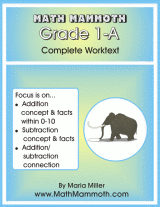
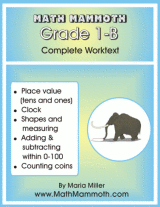
Welcome Math Mammoth to my homeschool repertoire! It is my newest discovery for math curriculum for the little guys. Math Mammoth is a traditional basic math curriculum geared mainly to grades 1-5 delivered to homeschoolers in a very non-traditional format.

Math Mammoth is available for purchase through the Math Mammoth website by downloading a PDF zip file of the entire text, purchasing a CD of the text or the more traditional format of a black and white bound hard copy of the text. Customers willing to purchase the e-book format option of a PDF download for their curriculum are rewarded through price and flexibility. Single topic downloads are priced around $3.00 per topic while entire curriculum downloads are merely $27.00.

Math Mammoth is written by Taina Maria Miller. She describes herself as “a math teacher turned housewife, homeschooler and website and book author.” She holds a master’s degree in mathematics with teacher educational studies and minors in physics and statistics and has teaching experience ranging from University to vocational school to classroom and private tutoring settings.

Miller has divided Math Mammoth into topical study allowing teachers to choose to purchase an entire topic at a time for their child (The Blue Series) or a complete curriculum for the school year (The Light Blue Series). Workbooks with worksheet exercises, but no textbook explanations, are available as well for grades 3-8 and Algebra 1. These worktexts are called the Golden Series. Winterpromise, a company specializing in unit study curriculum, is currently the only place customers can purchase black and white bound hard copies of Math Mammoth’s Light Blue Series for $52.00.


I selected Math Mammoth’s Light Blue Series Level 1A and 1B for my review. I was already familiar with Math Mammoth from a rave review I read last summer on the Winterpromise website. Math Mammoth promised to be a sensible basic math curriculum that took the time to properly explain and master topics before moving the young child onward in their mathematic studies. Because I struggled my entire life with math, I found this philosophy to be comforting and good common sense. Miller states in the foreward of Level 1A, “the curriculum aims to concentrate on a few major topics at a time, and study them in depth. This is totally opposite to the continually spiraling step-by-step curricula…”

Topics covered by Math Mammoth for first grade students include addition, subtraction, addition and subtraction facts, place value to 100, clock reading for the hour and half hour, measuring length in inches and centimeters, shapes and coins. The curriculum contains eight chapters with anywhere from 4-15 lessons per chapter each lesson containing one or two work pages. A wonderful tool called the “worksheet generator” is also included in the package. Because my computer is always connected to the internet I was able to access the worksheet generator web page through the live link written into the e-book. Magic!

The worksheet generator should be used if your child still appears to be struggling with a specific topic after completing the lessons. Say, for example, you are studying “The Clock” and your son, “Einstein” just can’t manage to grasp the concept with the lessons provided in the curriculum. Simply click on worksheet generator, choose the topic “clock” on the webpage, follow that up by clicking on the subtopic “Tell the time to the whole hour”, then choose between worksheets for “Draw the time on the clock face (whole hours)” “Tell the time to the half hour”, or “Draw the time on the clock face (half hours)”.

Once selected, clicking on your favorite subtopic will automatically produce a pop-up window with a worksheet ready for printing along with a secondary link for “answer key” which when clicked opens another pop-up window with the answer key page to match the newly generated worksheet. For the cost of a $27.00 curriculum you also receive a wealth of related resources to help make you the teacher of a gifted math student instead of a frustrated math student.

The complete curriculum includes tests for all 8 chapters plus an end of the year test which Miller warns is very long and should be broken up over several days. The tests are provided in Word, Adobe, and PDF formats or as a live link to a webpage. I found the web page format to be more colorful, appealing and easy to access.

My first grade math student has completed three of the lessons for chapter 1 since late November. We do not have a math lesson every day and usually only complete one or two brightly colored work pages in one sitting. Each printed page has between 12-15 problems most with colored pictures of items to count or add. The pages take Sierra between 10-15 mins. to complete, and review with me. I have not witnessed any frustration on her part with the curriculum, but after 15-20 mins. of concentrated math study she is usually ready to play a game or move on to another learning experience. I am not sure exactly what the recommended pace of the curriculum is, but I am very happy with our results thus far.

When I asked Sierra for a recommendation regarding Math Mammoth she was enthusiastic in saying, “It’s nice, because it can help me learn about math”. Pressed further for greater insight she replied, “I like the plusing and equaling. I think there are just enough problems on a page. I like the pictures, especially the dice”.

I didn’t think I would like having to print off my own math book for school, but now that I am in the midst of it, I do like it. I guess it is a bit of the “green eggs and ham” philosophy---don’t knock it until you try it. Yes, printing a hard copy of my e-book consumes ink. Yes, I need to be organized and find a three ring binder to collect the sheets in for my daughter. Yes, I sometimes forget to print out sheets ahead of time, or the printer is acting up, etc. and we skip math that day, but……Math Mammoth is easy to use, extremely teacher friendly, colorful and cute. It pleases the student and the teacher and from a math phobic writer like me that’s really high praise.